
Our Lady of Fatima Church | Newark, NJ
IGREJA DE NOSSA SENHORA DE FÁTIMA


BIOGRAFIA DE SANTO ANTÓNIO DE LISBOA
BIOGRAPHY OF SAINT ANTHONY OF PADUA
António nasceu em Lisboa (Portugal), por volta do ano 1195. Lisboa era, pois, uma cidade recém-cristianizada, quando na sua catedral foi a baptizar o menino Fernando Martins de Bulhões, filho da fidalga D. Teresa Tavera, descendente de Fruela, rei das Astúrias e de seu marido Martinho de Bulhões. Sabe-se que D. Teresa nascera em Castelo de Paiva e o marido numa terra próxima. Viviam em casa própria no bairro da Sé quando Santo António veio ao mundo, no ano de 1195, embora alguns apontem como data de nascimento 1190 ou 1191.
Fernando frequentou a escola da Sé e até aos 15 anos viveu com os pais e com uma irmã de nome Maria. Aos 20 anos professou nos Cónegos Regrantes de Santo Agostinho em Lisboa, no Mosteiro de São Vicente de Fora. Nesta ordem monástica prosseguirá os seus estudos teológicos. Pouco depois foi enviado para Coimbra ao mosteiro de Santa Cruz, onde tinha à sua disposição a melhor biblioteca monacal do País. Em Coimbra foi ordenado sacerdote.

Anthony was born in Lisbon (Portugal) around the year 1195. Lisbon was, therefore, a newly Christianized city when the boy Fernando Martins de Bulhões, son of the noblewoman Dona Teresa Tavera, descendant of Fruela, King of Asturias, and her husband Martinho de Bulhões, was baptized in its cathedral. It is known that Dona Teresa was born in Castelo de Paiva and her husband in a nearby town. They lived in their own house in the Sé district when Saint Anthony was born in 1195, although some point to 1190 or 1191 as his birth date.
Fernando attended the Cathedral school and until the age of 15 lived with his parents and a sister named Maria. At the age of 20, he professed in the Canons Regular of St. Augustine in Lisbon, at the Monastery of São Vicente de Fora. In this monastic order he would continue his theological studies. Shortly after, he was sent to Coimbra to the Monastery of Santa Cruz, where he had at his disposal the best monastic library in the country. In Coimbra, he was ordained a priest.
O mundo cristão vivia intensamente a época das Cruzadas, por causa da constante incursão dos muçulmanos, na tentativa de conquistar a Europa ao Islão. Os Cruzadas eram a resposta tardia a essa tentativa dos seguidores de Maomé. Os Muçulmanos acreditavam que a sua fé os levaria à vitória contra os cristãos. De Oriente a Ocidente os exércitos batalham, e neste turbilhão surgem novas formas de espiritualidade. Em 1209, Francisco de Assis (São Francisco) abandona o conforto e luxo da casa paterna, para, com outros companheiros, se recolher numa pequena comunidade, dando origem a uma nova reflexão sobre a vivência do Evangelho. É a aproximação à vida simples e à redescoberta da dignidade da pobreza preconizada pelos primeiros cristãos. Em poucos anos, homens e mulheres, alguns ainda bem jovens e filhos de famílias abastadas e poderosas sentem-se atraídos por esta vida de despojamento e sacrifício, com os olhos postos no exemplo de Cristo. A Portugal também chegaram ecos deste novo misticismo da nascente ordem de Frades Menores que hoje chamamos Franciscanos.
Em Janeiro de 1220 são degolados em Marrocos, pelos muçulmanos, cinco frades menores (franciscanos) e todo o mundo cristão sofre um enorme abalo. A própria Clara de Assis (Santa Clara), praticamente da mesma idade que Santo António (nasceu em 1193 ou 1194) vai querer partir para Marrocos para converter os sarracenos, mas Francisco de Assis seu amigo de infância e seu orientador espiritual não lho permite.
Em Portugal em meados de 1220 chegam, com grande pompa religiosa, ao convento de Santa Cruz de Coimbra, as relíquias dos mártires de Marrocos e esse acontecimento vai ser decisivo no rumo da vida de Santo António. O nosso futuro Santo António decide mudar de Ordem religiosa e também ele passa a envergar o hábito dos franciscanos. É nesta ocasião que muda o nome de baptismo de Fernando para António e vai viver com outros frades no ermitério de Santo Antão (ou António) dos Olivais, na altura um pouco afastado de Coimbra, nuns terrenos doados por D. Urraca, mulher do rei D. Afonso II.
Pede autorização e parte para Marrocos, sentindo também ele que é chamado a participar na conversão dos chamados infiéis, com a intenção de se dedicar à propagação da fé entre os povos da África. Porém adoece gravemente e não podendo cumprir aquilo a que se propunha, teve de embarcar de regresso a Lisboa. Só que o barco é apanhado numa tempestade e o santo vê o seu itinerário alterado ao sabor de uma vontade superior. Acaba por aportar à Sicília num período de grandes conflitos armados entre o Papa Gregório IX e o rei da Sicília, Frederico II. Relembra-se que várias regiões do que é hoje a Itália unificada eram reinos independentes onde se vivia um ambiente de guerras, gerador de insegurança e perigos.
Em Maio de 1221 os franciscanos vão reunir-se no chamado Capítulo Geral da Ordem, onde Santo António está presente. No final os frades regressam às suas comunidades, entre as quais, a de Montepaolo, perto de Bolonha, onde, a par da vida contemplativa e de oração, cabe também tratarem das tarefas domésticas do convento. Aqui os outros frades reparam na grande modéstia daquele português e jamais suspeitaram dos seus profundos conhecimentos teológicos. Findo aquele período de reflexão, como que um noviciado, os frades franciscanos são chamados à cidade de Forlì para serem ordenados e Santo António é escolhido para fazer a conferência espiritual. Ninguém até ali percebera até que ponto ele era conhecedor das Escrituras e como a sua fé e os seus dotes oratórios eram invulgares. Imediatamente cativou os outros frades e a sua vida seria a partir daquele dia de pregador da palavra de Cristo. Percorrerá diversas regiões da actual Itália, entre 1223 e 1225. Por sugestão do próprio São Francisco vai ser mestre de Teologia em Bolonha, Montpellier e Toulouse.
O bispo de Óstia, mais tarde papa com o nome de Alexandre IV, pede-lhe que escreva sermões para os dias das principais festas religiosas que eram já muitas na época. Mais tarde seria este papa a canonizá-lo. Santo António assim faz. São hoje importantíssimos esses documentos escritos, porque Santo António como pregador escreveu pouco. Apenas lhe são atribuídos Sermones per "Annum Dominicales" (1227-1228) e "In Festivitatibus Sanctorum Sermones" (1230).
Sentindo-se doente, Santo António pediu que o levassem para Pádua onde queria morrer, mas foi na trajectória, num pequeno convento de Clarissas, em Arcela, que Santo António veio a falecer. Era o dia 13 de Junho de 1231. Depois, como é sabido, foi canonizado, em 1232, ainda se não completara um ano sobre a sua morte. Caso único na história da Igreja, já que nem São Francisco de Assis teve tal privilégio.
The Christian world was intensely experiencing the Crusades, due to the constant incursions of Muslims attempting to conquer Europe from Islam. The Crusades were a belated response to this attempt by the followers of Muhammad. The Muslims believed that their faith would lead them to victory against the Christians. From East to West, armies battled, and in this turmoil, new forms of spirituality emerged. In 1209, Francis of Assisi (Saint Francis) abandoned the comfort and luxury of his father's house to, with other companions, retreat to a small community, giving rise to a new reflection on the living of the Gospel. It was an approach to simple life and a rediscovery of the dignity of poverty advocated by the first Christians. Within a few years, men and women, some still very young and children of wealthy and powerful families, felt drawn to this life of detachment and sacrifice, their eyes fixed on the example of Christ. Echoes of this new mysticism from the nascent order of Friars Minor, which we now call Franciscans, also reached Portugal.
In January 1220, five Friars Minor (Franciscans) were beheaded in Morocco by Muslims, and the entire Christian world suffered a huge shock. Clare of Assisi (Saint Clare), practically the same age as Saint Anthony (born in 1193 or 1194), herself wanted to go to Morocco to convert the Saracens, but Francis of Assisi, her childhood friend and spiritual guide, did not allow her to.
In Portugal, around 1220, the relics of the Moroccan martyrs arrived at the Santa Cruz convent in Coimbra with great religious pomp, an event that would be decisive in the life of Saint Anthony. Our future Saint Anthony decided to change religious orders and also began to wear the Franciscan habit. It was on this occasion that he changed his baptismal name from Fernando to Anthony and went to live with other friars in the hermitage of Santo Antão (or António) dos Olivais, at the time a little way from Coimbra, on land donated by Queen Urraca, wife of King Afonso II.
He asked for permission and left for Morocco, also feeling called to participate in the conversion of the so-called infidels, with the intention of dedicating himself to the propagation of the faith among the peoples of Africa. However, he fell seriously ill and, unable to fulfill his purpose, had to embark back to Lisbon. However, the ship is caught in a storm, and the saint's itinerary is altered according to a higher will. He ends up landing in Sicily during a period of great armed conflict between Pope Gregory IX and the King of Sicily, Frederick II. Remember that several regions of what is now unified Italy were independent kingdoms where an atmosphere of war prevailed, generating insecurity and danger.
In May 1221, the Franciscans gathered for the so-called General Chapter of the Order, where Saint Anthony was present. At the end, the friars returned to their communities, among them Montepaolo, near Bologna, where, alongside contemplative life and prayer, they also had to attend to the domestic tasks of the convent. Here, the other friars noticed the great modesty of this Portuguese man and never suspected his profound theological knowledge. After that period of reflection, like a novitiate, the Franciscan friars were called to the city of Forlì to be ordained, and Saint Anthony was chosen to give the spiritual conference. No one had yet realized how well he knew the Scriptures and how uncommon his faith and oratorical gifts were. He immediately captivated the other friars, and from that day forward his life would be that of a preacher of the word of Christ. He traveled through various regions of present-day Italy between 1223 and 1225. At the suggestion of Saint Francis himself, he became a master of Theology in Bologna, Montpellier, and Toulouse.
The Bishop of Ostia, later Pope Alexander IV, asked him to write sermons for the major religious feast days, of which there were many at the time. This same Pope would later canonize him. Saint Anthony did so. These written documents are extremely important today because Saint Anthony, as a preacher, wrote little. Only "Sermones per Annum Dominicales" (1227-1228) and "In Festivitatibus Sanctorum Sermones" (1230) are attributed to him.
Feeling ill, Saint Anthony asked to be taken to Padua where he wished to die, but it was during the journey, in a small Poor Clare convent in Arcella, that Saint Anthony passed away. It was June 13, 1231. Later, as is known, he was canonized in 1232, less than a year after his death. A unique case in the history of the Church, since not even Saint Francis of Assisi had such a privilege.
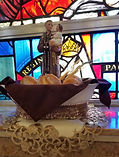
História do “Pão de Santo António”
A história do “Pão de Santo António” remonta a um facto curioso que nos é assim narrado: “António comovia-se tanto com a pobreza que, certa vez, distribuiu aos pobres todos os pães do convento em que viva. O frade padeiro ficou em apuros, quando, na hora da refeição, percebeu que os frades não tinham de comer: “os pães tinham sido roubados”.
Atónito, foi contar ao santo o ocorrido. Este mandou que verificasse melhor o lugar em que os tinha deixado. O irmão padeiro voltou estupefacto e alegre: os cestos transbordavam de pão, tantos que foram distribuídos aos frades e aos pobres que visitavam o convento.
A partir de acontecimentos como este, espalhou-se por todo o mundo, o costume de colocar nas igrejas uma caixa para esmolas do “Pão dos pobres”.
The Story of "Saint Anthony's Bread"
The story of "Saint Anthony's Bread" dates back to a curious event, narrated as follows: "Anthony was so moved by poverty that, on one occasion, he distributed all the bread from the convent where he lived to the poor. The friar baker was in trouble when, at mealtime, he realized that the friars didn't need to eat: 'the bread had been stolen.'
Astonished, he went to tell the saint what had happened. The saint told him to check the place where he had left the bread more carefully. The brother baker returned amazed and joyful: the baskets were overflowing with bread, so much that it was distributed to the friars and the poor who visited the convent.
From events like this, the custom of placing a box for alms for the 'Bread of the Poor' in churches spread throughout the world."